Reflecting on “The Doubly Exceptional Child Grows Up”

After reading the Musings of an Aspie post that led to my self-diagnosis, I read several more of her entries.  This is one I read with a special hunger, because I too was labeled “gifted” as a kid and we didn’t know I had Aspergers.  Unlike Cynthia Kim, I didn’t have a great gifted program at my school.  I was in 1st grade when I received the diagnosis and the next year  I was thrown in with some older kids (scary!) for the weekly activities. (If I recall correctly I was the first one in my grade to go, but one other girl may have started at the same time.)  I only have two clear memories of the program.  The first is building towers with straws in the library; I was frustrated when we were done and I saw the superior techniques the other kids had used. The second was using an SLR camera. We were given note cards saying what we were to photograph, and mine said “blacktop” – I was super embarrassed when I had to ask the teacher what it was and she told me I was standing on it.  Today I asked Mom a few questions to check my own memories of the timeline. She said she talked to my 2nd grade gen-ed teacher and they agreed that to me it felt more like a punishment, so they let me quit the program.

Fortunately I wasn't permanently deterred from learning to use an SLR.

Fortunately I wasn’t permanently deterred from learning how to use an SLR.

In fifth grade a went to a different school (I was bored; they promised I could work at my own pace; they lied).  I enjoyed the gifted program there, mostly because I had a crush on one of the boys.  When I returned to public school the next year I continued in the program.  From what I recall the teacher was pretty cool and really nice to me, but my peers. . . well. . . they were all girls, and at this point the bullying and social awfulness had started (and in junior high the gifted class ended up being one of my worst settings socially).  But that’s a topic for another day.  In 9th the teacher who normally had the gifted kids for a period was ill, and the sub didn’t do much with us, so it was basically a fun study hall. That was my last experience with the gifted program.  Junior and senior high were academically better for me because there were accelerated and AP courses to take.

Back to the post titled “The Doubly Exceptional Child Grows Up.”  I hope you’ll read it in its entirety, but here are a few of my favorite key quotes:

Adults wrote off our quirks as a byproduct of our intelligence. They sent us out to the playground and expected us to figure out how to navigate the social minefields that lurked within kickball games and jump rope circles. We were smart. We would get it eventually.

This is a bit like taking a kid who’s a good baseball player, throwing him in the pool, then being surprised if he sinks like a rock. What do you mean he can’t swim? If he’s athletic enough to hit a baseball, surely he’s athletic enough to swim.

When you arrive in adulthood lacking the social skills that most people have mastered by sixth grade, life becomes exponentially more confusing and hard to navigate. For much of my adulthood, I’ve had the odd belief that someday I would “grow up” and suddenly feel like an adult. That I was just a little behind the curve when it came to social skills and one day everything would magically fall into place.

A final note for today about giftedness. When I was in college, I took as an elective an education course titled Psychology of the Exceptional Child (special education).  Our wonderful professor put the bell curve up on the board, and reminded us that two standard deviations below the mean on an IQ test meant a child received an MR diagnosis (now Intellectual Disability) whereas children two standard deviations above the mean were labeled Gifted. Children in the first group generally spend most of their school day in a special classroom, and children in the second group spend maybe an hour a week in a special classroom. Yet the second group is just as different from their typical peers as the first group is. That kinda blew my mind, and it helped me feel a little more understanding towards myself. It also helped explain why I felt so very different, though I hadn’t yet discovered the biggest missing puzzle piece.

Hmm.   I wonder about the percentage of people at the right end of the bell curve who are also Aspies.  Let’s research. . . first interesting Google result- here’s a great article about Gifted children with Asperger’s Syndrome  – it includes a chart showing some differences between Gifted and AS kids as well as some strategies for helping the AS kids.  I’m heading down a rabbit trail and have “real life” stuff to work on today, but I’d love to look into this more.  If you have any thoughts or research to share, leave a comment!

Change

Change, you say?  My dad and I respond this way:

We quote it often.  In fact, I got this text from my dad this morning while I was at work – “We fear change. But I think you’ll like it.”

Ominous, isn’t it?

By the time I got home to the empty house I had completely forgotten about his text.  I was heating up some food for dinner, and while it cooked I opened the cupboard to retrieve a small glass for my grape juice.

HORROR. 

Those are not glasses.  Those are mugs.  They belong on the left side of the sink.  This is the right side of the sink.

Cue a short spell of hyperventilating, hand-flapping, and pacing, all while processing  – “AHHH CHANGE.  It makes sense.  That’s above the coffee makers. BUT IT’S NOT THE SAME.  The other cups are now beside the cupboard that holds Mom’s tall glasses.  It makes sense.  IT’S NOT OKAY.  It’s logical.  It’s practical. BUT IT DOESN’T LOOK RIGHT.”

To be honest I was concurrently amused at my response.  I think if I had been more specifically forewarned I wouldn’t have had quite the same reaction.  And because it’s such a practical and logical change I’ll be cool with it soon.

An Aspie Anthem

I enjoy Toad the Wet Sprocket‘s music.  (They get bonus points for inadvertently sparking the formation of my all-time favorite band.)  After a very long hiatus this classic 90’s rock band reunited and released an awesome new album called New Constellation.  I had the opportunity to be one of their Kickstarter backers and download the tracks in early July, so this album was on heavy rotation when I realized I have Aspergers.

Have you ever had one of those moments where a song pops into your head and you don’t know why, but when you look up the lyrics or listen to the song you realize it perfectly fits your mood or the situation you were thinking about?  I had one of those moments with this song. It works so well as an Aspie anthem – sensory issues, defenses, feeling alone, wanting to “reach across the breach,” language issues, needing others even though we seem to disappear sometimes.

You can pick up the album/track on iTunes, Amazon, etc. . . and it turns out you can listen to the full track over on myspace, which is apparently still a thing.

“Is There Anyone Out There”

A swarm of senses, a shatterstorm
Tangled threads to weave a world
We build defenses and call them homes
Each alive, alert, alone

Is there anyone out, is there anyone out there, hey, hey
Is there anyone out, is there anyone out there calling for you
‘Cause I don’t know how to reach across the breach so deep between us
Is there anyone out, is there anyone out there
Who feels the way I do

Uncertain language, imperfect words
How can we expect to speak the truth
I need you closer
I need you still
No matter how I seem to disappear from you

Is there anyone out, is there anyone out there, hey, hey
Is there anyone out, is there anyone out there

The world I’ve seen it seems no-one could ever know
The same as every other one of seven billion souls

Is there anyone, is there anyone out there
Is there anyone out, is there anyone out there, I’m calling for you
‘Cause I don’t know how to reach across the breach so deep between us
Is there anyone out, is there anyone out there
Who feels the way I do

Emotional Overload

Last night would have been a lot more difficult if I hadn’t been able to view it through the lens of having Aspergers.


I was having a good Sunday.  I had no problems running sound during the morning service, ordered a new lens to use during portrait sessions, started a sewing project after a month away from the machine, and began watching a favorite TV series over again in a very Edwardian fashion (if you haven’t read 600 Hours of Edward – go do it).  Then to top it all off, after I shared the link to my Inland post with the band through facebook, Charlie from Jars of Clay liked the post.  I always appreciate when they appreciate my appreciation, you know? 😉   It was time for dinner and I was excited to tell my family about the latest interaction with my favorite band.

But then my phone rang.

Fortunately I didn’t answer.  I don’t know if I would have responded well if I had.  The caller left a message and leveled a false accusation against me.

I’m not sure how to accurately describe the emotions I felt.  My heart raced and I felt like I was shaking (I don’t know if I was physically shaking, but it at least felt that way emotionally).  I felt like my temperature dropped. A lot of times I ask my autistic client, “How do/did you feel?”  And he almost always responds, “Upset,” instead of giving me a more specific word like “Sad” or “Mad” or “Scared.”  Last night I felt “upset.”

I was dumbfounded by the accusation and by the fact that the person actually called me.  I went downstairs and told my family.  Through my new lens of self-awareness I noticed a lot of things.  I noticed I was talking too loudly.  I noticed my family was going to be done eating by the time I finally took more than a single bite, because I was too upset and too busy venting to eat.  I noticed that I kept forcing myself to take big deep breaths, same as I prompt my client.  I noticed (and even commented aloud) that I felt like rocking.

I noticed that my mom kept reassuring me that I had acted above reproach in the situation the call seemed to be referring to, and I kept trying to explain that I knew I hadn’t done anything wrong, but I was still upset.  I wasn’t upset because I thought I had done something wrong.  I was upset because I KNEW I hadn’t, and I was being thought of and talked of as if I had done something wrong.  And that’s NOT FAIR.  I have always had issues with “fairness.”  I was upset because I thought I wasn’t going to have to deal with any more drama from that specific part of my past, yet it kept coming up.  I was upset because I was under attack and there were just too many emotions (my own and the accuser’s) to process.

I managed to shove down my dinner through deep breaths and exhaled nonverbal sounds of frustration.  I had to eat so I could leave for Bible study.  I got out to my car and my mind was still churning over the situation, and I was spiraling downward.  I stopped my car before even leaving the driveway and switched the CD to Jars of Clay’s Self-Titled album.  It is my go-to record when I am desperately upset; it is the most effective medication available to soothe my soul.  I turned up the volume and sang along to reduce my ability to ruminate.  It’s a 20-minute drive, and during the last 5 I found it impossible to turn off my thoughts of what I wanted to say about what just happened.  Right before I turned into my pastor’s driveway I started crying – those unwanted tears of emotional overload that cause me so much frustration that I cry even more.  I hate those.  I took a few deep breaths and dried my eyes, then walked in.

I was still visibly shaken; my pastor’s wife immediately asked me what was wrong.  Before group began I was able to briefly discuss the situation with my pastor and his wife, who are two of my most trusted counselors.  My pastor advised me to ignore it; I nodded and said, “Yeah, I’m just feeling all. . . ” and waved my hands on either side of my head, unable to articulate what it was I was feeling.  Then instead of taking my normal seat on the floor I sat in the rocking chair.

And rocked for two hours straight.

I’m feeling much better today.

Reflecting on “Aspergers Traits (Women, Females, Girls)”

"Reflection"

“Reflection”

This is one of the posts I read right after my self-diagnosis.  It is a post that still brings tears to my eyes when I read it again, because it accurately and eloquently describes so much of my life experiences and struggles.  It is one of the best pieces I’ve found in my process of reflecting on and re-framing my past.  I hope that you will take the time to read it – if you’re an Aspie, you may feel self-awareness and solidarity; if you are not, you may feel a new sense of understanding and empathy.  (Because despite all of the talk about autistics and empathy, I find most NTs lack empathy towards autistics!)

I could comment on every point she makes, but this is one that stands out to me as extremely validating; it describes one of the biggest social struggles I faced as a kid:

We aren’t narcissistic and controlling–we know we are not, but we come across that way. We bring the subject back to ourselves because that is how we make sense of our world, that is how we believe we connect. We use our grasp of the world as our foundation, our way of making sense of another. We share our feelings and understandings in order to reach out. We don’t mean to sound ego-centered or over zealous. It’s all we know. We can’t change how we see the world. But we do change what we say. We hold a lot inside.

Without further ado, here is the link:

Click here to read “Aspergers Traits (Women, Females, Girls)” on Everyday Aspergers

Unwell

I was driving home the other night and this song came on my iPod.  I chuckled as I remembered how often my roommate and I would quote the line, “I’m not crazy, I’m just a little unwell.”  I mused that it could be a theme song for me.  I re-started the song and really listened to the lyrics as I sang along. . . and I started to sob.

All day staring at the ceiling
Making friends with shadows on my wall
All night hearing voices telling me
That I should get some sleep
Because tomorrow might be good for something

Hold on
Feeling like I’m headed for a breakdown
And I don’t know why
But I’m not crazy, I’m just a little unwell
I know right now you can’t tell
But stay awhile and maybe then you’ll see
A different side of me
I’m not crazy, I’m just a little impaired
I know right now you don’t care
But soon enough you’re gonna think of me
And how I used to be . . . me

I’m talking to myself in public
Dodging glances on the train
And I know, I know they’ve all been talking about me
I can hear them whisper
And it makes me think there must be something wrong with me
Out of all the hours thinking
Somehow I’ve lost my mind

But I’m not crazy, I’m just a little unwell
I know right now you can’t tell
But stay awhile and maybe then you’ll see
A different side of me
I’m not crazy, I’m just a little impaired
I know right now you don’t care
But soon enough you’re gonna think of me
And how I used to be

Ive been talking in my sleep
Pretty soon they’ll come to get me
Yeah, they’re taking me away

But I’m not crazy, I’m just a little unwell
I know right now you can’t tell
But stay awhile and maybe then you’ll see
A different side of me
I’m not crazy, I’m just a little impaired
I know right now you don’t care
But soon enough you’re gonna think of me
And how I used to be

Yeah, how I used to be
How I used to be
Well, I’m just a little unwell
How I used to be
How I used to be
I’m just a little unwell

© EMI Music Publishing

Inland

When it comes to interpreting art, I’m usually pretty black-and-white.  I am a firm believer in Truth, that there is absolute truth out there.  I hated having to interpret poems and stories in English class – I’d think, “I don’t know what the author meant by that.  I haven’t asked them.”  I’d get annoyed if a songwriter, when asked what a song was about, would say something like, “It can mean different things to different people.”  I understand what they’re saying, but it still vexes me.  Normally I want to know what a song is truly about, the true meaning behind the words, from the person who wrote it.  So it always surprises me when I come across a piece of art and can experience it meaning something personal to me, something different from what it meant to the artist.

Matt Odmark


Jars of Clay is my favorite band.  Fixation-level favorite.  Their music resonates with me, even when I don’t always “get” the lyrics – I still resonate with the “feel” of the songs.  I was listening to a few tracks from their latest record before the full album was released, and it was around that time that I realized I am an Aspie.  So while thoughts about my self-diagnosis were swirling through my head, this song was also swirling around in there.  And because I like finding patterns and connections, I recognized my journey in some of the lyrics.  I hope you’ll listen to the song before reading on:


They don’t believe in oceans, you, you were a sailor

Who burned your ship and walked on, far away you walked on

“It is a song about walking toward mystery and not being afraid to take risks,” Jars of Clay’s Dan Haseltine tells Rolling Stone. “The idea came from Homer’s Odyssey. In the story, Odysseus, a man who lived his life on the sea, is provoked, to take his oar and walk inland until he finds someone who doesn’t know what an oar is.”

This reminds me of what it feels like trying to enter the neurotypical world.  It’s a land where I have my oar and describe the sea (a very real object and a very real place I’ve experienced and know well) but they can’t comprehend what I’m talking about.  They may even think I’m making it up.

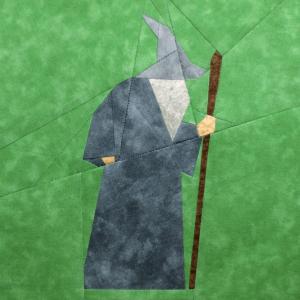
Yes, it's Gandalf.

Yes, it’s Gandalf.  He’s walking.  Not all who wander are lost…


There are no streets to walk on, no maps you can rely on

Faith and guts to guide you, wander ‘til you find you


Growing up undiagnosed, I didn’t have any maps or guides to help me navigate. Fortunately awareness and resources are increasing, but it still involves a lot of that “wander ’til you find you” stuff.


You keep turning inland where no man is an island

It’s where you’re supposed to be

I’m encouraged to make the effort to connect with others, instead of trying to be an island.  Even though it takes a lot of energy, in relationship and community is where I’m supposed to be.

My kitten Gandalf looks through an Inland vinyl. See, it all connects.


Afraid of your conviction, they said the land would change you

Steady your confession, your course make no corrections

When you are a stranger, hold your tongue and wager

That love will set you free, until it sets you free


It’s hard to feel like a stranger, but people will love us.  And the land will change us.  Hopefully we can change it for the better, as well.


Follow your desire, leave it all, you’re leaving all

Just burn it in the fire

Of everything you once knew

And everyone that knew you

Remove the shoes you came on

Feel the earth you’re made from

Pack up all your questions

Just keep heading inland and come on home to me


I can dwell too much on the past, especially the hard parts.  I dwell on how others treated me, times I was misunderstood, times I misunderstood and hurt others, etc.  And while it’s important to consider the past and how it shapes us, at times we need to “leave it all behind” in a sense.  I also dwell on unanswered questions – it can be good to pack them up and keep moving forward.

One of my favorite shots of the band, from 2005.

One of my favorite shots of the band, from 2005.


I will always be here by your side

I will always stand next to you

Where your darkness hits the light

In the place where you stand against the tide

I will always stand next to you

I will always stand next to you

I will always be here by your side

I’m thankful for the people in my life who love and support me unconditionally, even when they don’t understand me.  I have been blessed.

And of course I’m thankful for the guys of Jars of Clay.

1040398_683626884772_77765926_o

I’m as close to the Spectrum as you can be without being diagnosable. . . or am I?

Hi.  My name is Schenley.  Here’s a little bit of information about me that is relevant to today’s topic of discussion.

I’m 29 years old.  I’ve been studying autism ever since my little cousins were diagnosed when I was in high school.  I got a BA in psychology. I discovered the Highly Sensitive Person website in college, and it really helped me re-frame my life experiences and develop better coping skills.  I’ve worked as a TSS with autistic kids for over 3 years.  I diagnosed my dad with Aspergers a few years ago, and I’ve long joked about our “autistic tendencies.”

On July 25, 2013, I was chatting with an Aspie guy, and with the topic of Aspergers on my mind I found a link I had shared with my mom months earlier. (I thought she’d be interested in reading about an AS/NT marriage where the woman was the Aspie.) I clicked the link and somehow ended up reading her post titled “When Being a Good Girl is Bad for You.”

Here are what my thoughts sounded like as I read it:

Huh.  I was a conscientious “good girl” too.

But. . . why wouldn’t your Nancy Drew mysteries be lined up in numerical order?  That just makes sense.  It’s how it should be.  All of my Animorph books were in order.  I organized my collections, too.  I remember having a case to sort all of my little colored erasers, and compulsively organizing Crayola boxes of 96 crayons into meticulous rainbow order.

photo by bookgrl

Everyone called me “shy,” too.

The section called “Aspies at Play” – this is where things got intense.

“God mode”  – Wow.  I know being bossy was my biggest social deficit as a kid, and I struggled for years to overcome it.  It was tough.

The difference between boys’ games and girls’ games – I always preferred things like playing video games with the guys (something I was good at) to role-playing with the girls.  Playing with children as an adult (as a nanny, babysitter, or TSS) I am still that way.  I thought it was just because I was a “tomboy” instead of a “girly girl,” but it’s more than that.

“isolation, bullying and depression” – words I know too well.

By the end of this blog post my perspective had changed.  I was not just “as close as you can get to the Spectrum without being diagnosable.”

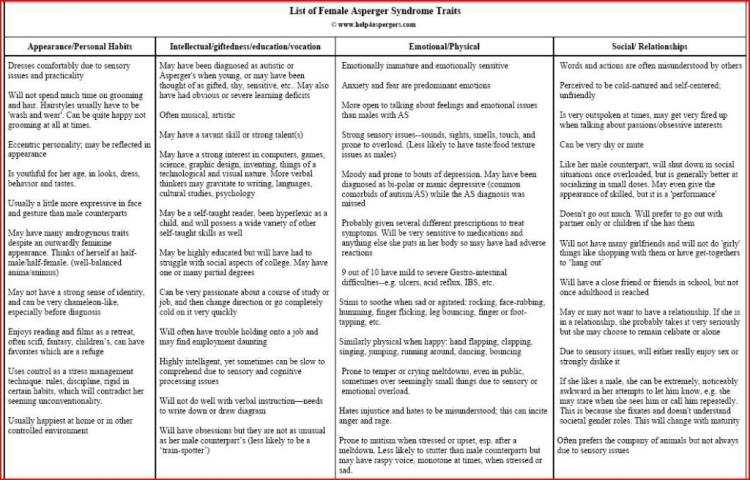
Seeing this chart sealed the deal.  

I quickly showed it to people closest to me.  My mom is certain that if there had been more awareness, I would have been diagnosed as a kid.
Thus began my quest for more knowledge and self-understanding, reading blogs and books about women with Aspergers.  Reading the blogs, I’ve been going back-and-forth on the idea of starting my own blog.  Do I want to let people I know deeper inside my heart and head, or would I want to write anonymously?  Would I even be able to write honest, detailed posts without giving away my identity if someone who knows me read it?  Do I have anything worth saying?  Could it be therapeutic to write, anyway?  Do I really have the time to take on yet another project?

I’ve decided to give it a shot.  To start I’d like to revisit some of those posts from other women that really hit home and made me feel less alone, that helped me understand myself.  To reflect on those first, interspersing more independent writings as I go.  Baby steps.  Unlike my quilt patterns or photography, I have no agenda, no desire for recognition or monetary gain here.  It’s an experiment, and a less structured one than I’d normally like.  Baby steps 😉

And I’ve decided to not try to hide my identity as the author of this blog.  Most of my life as an undiagnosed Aspie has involved feeling invisible.  Feeling like I had to hide my true thoughts and feelings.  What good has that done me?  It’s time to be real.  I’ve always been an honest person- I’m an Aspie, after all – but too often I’ve held my tongue or stayed hidden.

So like she says in this video I watched recently – I’m coming out of the closet.